
Understanding Presbyopia: Clear Vision at Every Age
A complete guide to age-related near vision loss—what causes it, how to recognize it, and the options available to help you see clearly again.
What is Presbyopia?
Presbyopia is the gradual loss of your eye's ability to focus on nearby objects. It's a natural part of aging that typically becomes noticeable in your early to mid-40s and continues to progress until around age 65.
Key Facts
Did You Know? The word “presbyopia” comes from Greek presbys (old man) and ops (eye).
Why Presbyopia Happens
Presbyopia is not a disease. It is a normal, age-related change in how your eyes focus—one that every person will experience if they live long enough.
Primary Cause
Gradual thickening and loss of flexibility of the natural crystalline lens inside your eye. As the lens becomes less elastic, it can no longer change shape easily to focus on close objects.
Secondary Factor
Weakening of the ciliary muscles that control lens shape. Over time, these muscles lose some of their ability to contract and relax precisely, compounding the focusing difficulty.
Contributing Factors
Age is universal, but certain medications (antihistamines, antidepressants), cardiovascular disease, diabetes, and multiple sclerosis may influence how early or noticeably symptoms appear.
What It Is Not
Presbyopia is not caused by eye strain, reading habits, or nutrition. It is not preventable through exercises or supplements, and it is not the same as farsightedness.
Important clarification: Presbyopia is not caused by eye strain, reading habits, or nutrition. It is not a disease, but a normal age-related change.
Recognizing the Signs
Presbyopia develops gradually. Most people notice subtle changes in their early 40s before symptoms become unmistakable.
These symptoms can overlap with other conditions. A comprehensive eye examination is essential for accurate diagnosis. This information is educational and not a substitute for professional assessment.
Quick Self-Assessment
Check the symptoms you have experienced recently. This is not a diagnosis.
How Presbyopia is Diagnosed
A comprehensive eye exam is the only way to confirm presbyopia and rule out other conditions with similar symptoms.
Visual Acuity Test
Measures how clearly you see at various distances using a standard eye chart.
Refraction Assessment
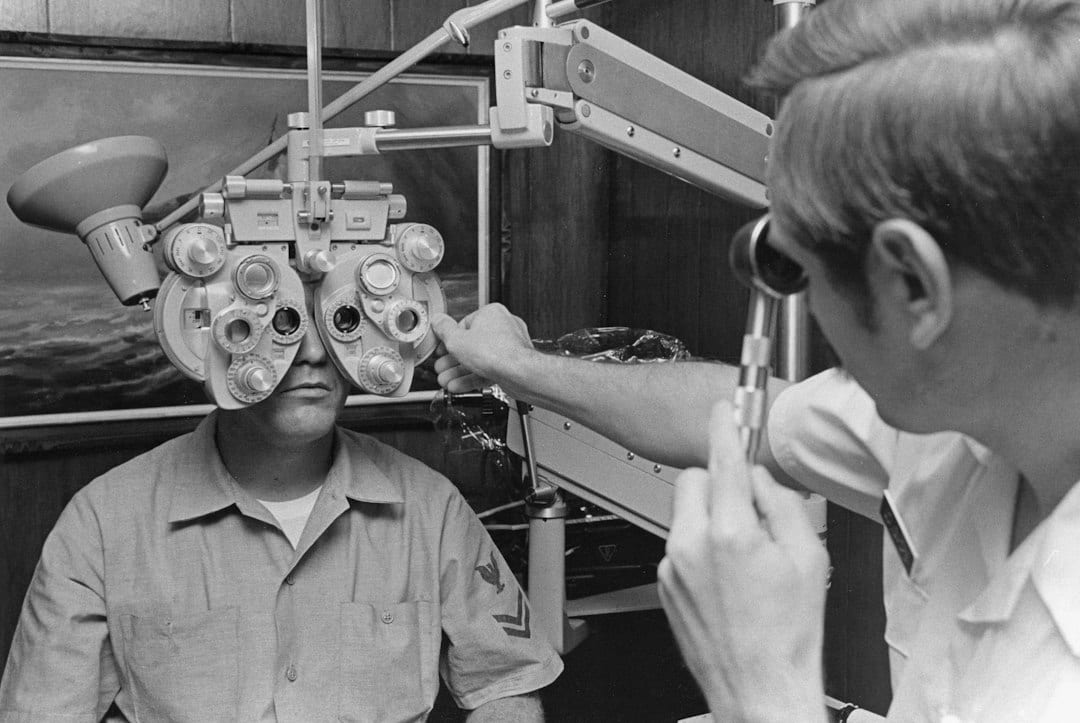
Determines the exact lens power needed to correct your near vision using a phoropter or autorefractor.
Near-Point Testing
Assesses the closest distance at which you can focus comfortably on small text—often the first objective sign of presbyopia.
Slit-Lamp Examination
Allows the practitioner to examine the structures at the front of your eye, including the cornea, iris, and lens.
Dilated Fundus Exam
Examines the retina and optic nerve to rule out other causes of vision change and assess overall eye health.
What to Expect
Your appointment typically lasts 30–45 minutes. Bring your current glasses, a list of medications, and be prepared for temporary light sensitivity if dilation is used.
How Often to Test
Every 1–2 years after age 40, or as advised by your eyecare professional. More frequent checks may be needed if you have diabetes, high blood pressure, or a family history of eye disease.
Differential Diagnosis
Your practitioner will distinguish presbyopia from hyperopia, accommodative dysfunction, and convergence insufficiency to ensure the right management plan.
Who to See
| Provider | Best For | Typical Services |
|---|---|---|
| Optometrist | Routine eye exams, prescription updates, lens recommendations | Comprehensive exams, refraction, contact lens fitting, referral to specialists |
| Ophthalmologist | Surgical consultation, complex cases, co-existing eye disease | Medical and surgical eye care, cataract and refractive surgery, disease management |
Practical Tips for Daily Life
Small adjustments to your environment and habits can make near vision tasks more comfortable while you explore correction options.
Workplace Ergonomics
Position your monitor 50–70 cm away, use adjustable task lighting, and follow the 20-20-20 rule: every 20 minutes, look at something 20 feet away for 20 seconds.
Reading Strategies
Use direct, adjustable lighting; explore large-print editions; and increase text size and contrast on e-readers and smartphones.
Driving Considerations
Ensure your distance prescription is current. If you wear progressive lenses, confirm that your driving posture aligns with the distance zone.
Hobby Adaptations
Improve craft lighting, use handheld magnifiers for fine detail work, and enable accessibility features like zoom and voiceover on devices.
Managing Multiple Pairs
Keep reading glasses in consistent locations—desk, bag, bedside. Consider a small case to protect progressives when not in use.
Lighting Matters
Brighter light makes near tasks easier because a smaller pupil increases depth of focus. LED task lamps with adjustable arms are especially helpful.
When to Update Your Prescription: Schedule a review if you notice increased headaches, need to hold text farther away again, or your current lenses no longer feel comfortable for your typical daily tasks.
Myths vs Facts
Misconceptions about presbyopia are common. Here is what the evidence actually says.
Myth Reading glasses make your eyes weaker.
Fact Reading glasses reduce eye strain and make near tasks comfortable. Presbyopia progresses regardless of whether you wear correction—glasses do not accelerate it.
Myth Eye exercises can reverse presbyopia.
Fact No clinical evidence supports this. The loss of lens flexibility is a structural change that exercises cannot restore.
Myth If you have LASIK, you won't get presbyopia.
Fact LASIK corrects refractive error by reshaping the cornea. It does not prevent the natural aging of the lens inside the eye.
Myth Bifocals are the only option after 40.
Fact Multiple modern alternatives exist, including progressive lenses, multifocal contacts, corneal inlays, and surgical options.
Find Presbyopia Care Near You
Search for optometrists, optical shops, and eye clinics offering presbyopia services in your area.
Explore Eye Clinics & Optometrists
Browse optometrists and eye clinics in Singapore offering presbyopia correction and comprehensive eye exams.
Filter by Service
Narrow results by progressive lenses, multifocal contacts, surgical consultation, or comprehensive examination.
Are You an Eyecare Provider?
Help patients find your presbyopia services. Claim your Sightpedia profile, showcase your expertise, and connect with consumers actively seeking vision solutions.
Frequently Asked Questions
What age does presbyopia usually start?
Presbyopia typically becomes noticeable between ages 40 and 45, though the exact timing varies by individual. Most people experience meaningful changes in near vision by their mid-40s.
Can presbyopia be prevented?
No. Presbyopia is a natural age-related change in the eye's lens and cannot be prevented by diet, exercise, or eye training.
Will I need reading glasses forever?
Most people use some form of near-vision correction indefinitely after presbyopia begins. The type of correction may change over time as needs evolve.
Is presbyopia the same as farsightedness?
No. Presbyopia is caused by loss of lens flexibility with age. Farsightedness (hyperopia) is a refractive error present from youth due to eye shape.
Can I wear contact lenses for presbyopia?
Yes. Multifocal contact lenses and monovision are common options. A qualified practitioner can help determine which design suits your eyes and lifestyle.
Does LASIK correct presbyopia?
Standard LASIK does not prevent or correct presbyopia. Monovision LASIK is an option for some patients, but it involves trade-offs and requires careful evaluation.
How often should I have my prescription checked?
Every 1 to 2 years after age 40, or as advised by your eyecare professional. More frequent checks may be needed if symptoms change quickly.
Can presbyopia get worse?
Yes. Presbyopia typically progresses until around age 65, after which near-vision requirements often stabilise.
Are there any new treatments for presbyopia?
Emerging options include accommodative IOLs, corneal inlays, and pharmacological eye drops. Availability and candidacy vary by region and individual eye health.
Is presbyopia covered by insurance?
Coverage varies by plan and country. Routine refractive correction is often self-funded, while medically necessary examinations may be partially covered.
Medical disclaimer: This information is for educational purposes only and does not constitute medical advice. Always consult a qualified eyecare professional for diagnosis and treatment recommendations. Editorial policy · Privacy policy
Last updated: November 2026